Context Aware Grounded Teacher
for Source-Free Object Detection

A bias-aware SFOD framework that grounds the teacher through relational context modeling, semantic augmentation, and expert foundational supervision, achieving new state-of-the-art on natural and medical imaging benchmarks.

🧠  Accepted in International Journal of Computer Vision
1 Department of Computer Vision, MBZUAI, Abu Dhabi, UAE 3 GAASH Research Lab, NIT Srinagar, J&K, India 4 Microsoft Research India, Bengaluru, India
* Corresponding author  ·  † Equal contribution

Abstract

Source-free object detection (SFOD) faces persistent challenges due to class imbalance–driven context bias and instability in teacher–student training under noisy pseudo-labels. Existing techniques tend to ignore the context bias and class imbalance shift, especially in medical data. To tackle this, we propose Grounded Teacher (GT), a bias-aware source-free framework that grounds the teacher model through relational and semantic regularization. GT introduces a Relational Context Module (RCM), which maintains an EMA estimate of cross-domain contextual bias, modeling directional inter-class confusions. Building upon this, a Semantic Augmentation (SA) strategy selectively augments minority and confusable classes through adaptive MixUp in both source-similar and source-dissimilar target regions. A Semantic-Aware Loss (SAL) applies diagonally normalized weights, preventing gradient explosion while emphasizing minority–majority corrections. Additionally, a frozen Expert branch derived from large vision foundation models (LVFMs) serves as a supervisory reference during training, refining pseudo-label quality without adding inference overhead. Evaluations on Cityscapes→Foggy (50.8 mAP) and medical transfers (+5.9 AP50 on DDSM→INBreast) show consistent gains and improved minority-class detection, with less than 12% additional training cost.

Why SFOD Remains Hard

Three compounding problems existing methods fail to address simultaneously

⚠️

Mode Collapse via Pseudo-label Noise

Biased teacher models produce skewed pseudo-labels. As EMA propagates student weights back, error accumulates and the teacher collapses—predicting only dominant classes.

🔀

Severe Domain Shift

Source-free setting prohibits access to source data during adaptation. Models must transfer knowledge blindly, compounding context bias under large source-target gaps.

⚖️

Class Imbalance in Medical Data

Breast-cancer datasets like DDSM have severe imbalance; most images lack majority-class instances. Conventional image-level resampling is ineffective for detection.

How Grounded Teacher Works

Three interlocking modules that break the bias-collapse cycle in source-free settings

MODULE 01

Relational Context Module (RCM)

Maintains an EMA-updated global confusion matrix across training. Models directional inter-class confusions so downstream augmentation and loss focus on genuinely problematic pairs.

MODULE 02

Semantic Augmentation (SA) + Semantic-Aware Loss (SAL)

RCM-guided relation-MixUp blends minority instances with their most-confused majority neighbours from a FIFO Cropbank. SAL applies diagonal-normalized, bounded weights to classification loss—preventing gradient explosion while amplifying minority corrections.

MODULE 03

Expert Foundational Branch

A frozen Large Vision Foundation Model (LVFM — BioMedParse for medical, GroundingDINO for natural) supervises the student via pseudo-label regression + SAL. Training-only: zero inference overhead.

EMA update Teacher ← Student weights Pseudo-label feedback Filtered by τ = 0.8 confidence Expert supervision Training-only · no inference cost Domain split Variance-based source-similar / dissimilar

Framework Architecture

The GT framework consists of a student–teacher pair connected by EMA weight updates. The Relational Context Module sits between them, maintaining a running confusion matrix that guides both the Cropbank sampling strategy and the Semantic-Aware Loss.

A frozen Expert Branch (BioMedParse / GroundingDINO) provides an additional supervision signal to the student during training. At inference, only the student runs, the expert adds zero latency.

The variance-based domain splitter partitions target images into source-similar and source-dissimilar subsets, allowing tailored augmentation strength in each region.
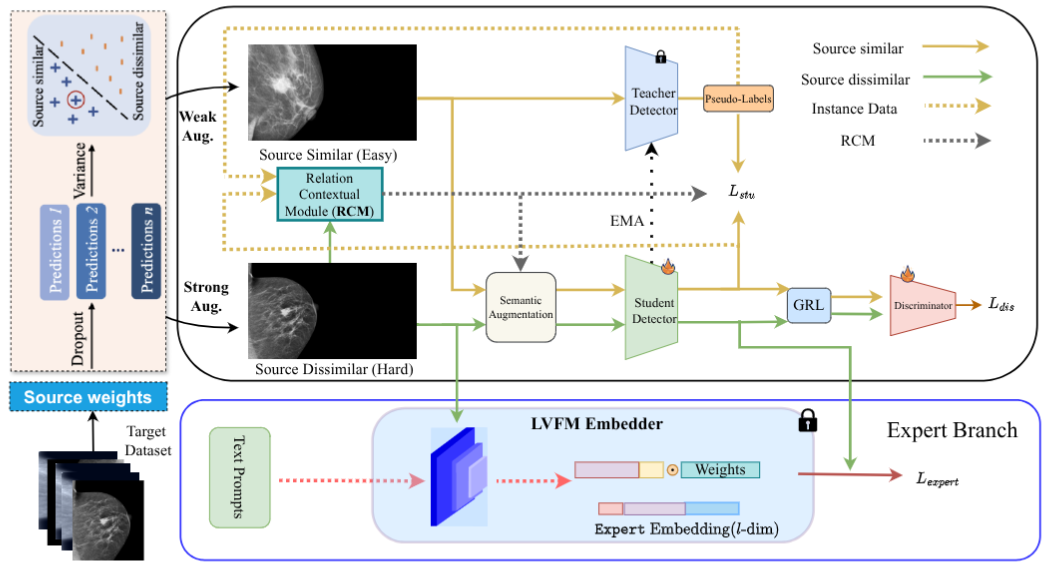
Grounded Teacher Architecture Diagram

State-of-the-Art Performance

Evaluated on natural and medical domain adaptation benchmarks

Table 4 — Cityscapes → Foggy Cityscapes
Method SF Venue Person Rider Car Truck Bus Train M.cycle Bicycle mAP
Source Only 22.4 26.6 28.5 9.0 16.0 4.3 15.2 25.3 18.4
DA-Faster CVPR'18 29.2 40.4 43.4 19.7 38.3 28.5 23.7 32.7 32.0
EPM ECCV'20 44.2 46.6 58.5 24.8 45.2 29.1 28.6 34.6 39.0
AT CVPR'22 43.7 54.1 62.3 31.9 54.4 49.3 35.2 47.9 47.4
MRT ICCV'23 52.8 51.7 68.7 35.9 58.1 54.5 41.0 47.1 51.2
SFOD-Mosaic AAAI'21 25.5 44.5 40.7 33.2 22.2 28.4 34.1 39.0 33.5
HCL NeurIPS'21 38.7 46.0 47.9 33.0 45.7 38.9 32.8 34.9 39.7
LODS CVPR'22 34.0 45.7 48.8 27.3 39.7 19.6 33.2 37.8 35.8
IRG CVPR'23 37.4 45.2 51.9 24.4 39.6 25.2 31.5 41.6 37.1
PETS ICCV'23 46.1 52.8 63.4 21.8 46.7 5.5 37.4 48.4 40.3
SF-UT ECCV'24 40.9 48.0 58.9 29.6 51.9 50.2 36.2 44.1 45.0
LPLD ECCV'24 39.7 49.1 56.6 29.6 46.3 26.4 36.1 43.6 40.9
OursGT IJCV'26 42.7 55.4 61.7 40.7 62.0 54.6 39.1 53.0 50.8
Oracle 66.3 61.1 80.8 45.6 68.8 52.0 49.1 54.9 59.8
Medical Imaging Benchmarks (FROC Recall & F1)

Table 1 — DDSM → INBreast (large-to-small, digitised film → full-field digital)

Method SF Venue R@0.05 R@0.30 R@0.50 R@1.00 AUC F1
IRG CVPR'23 0.05 0.05 0.07 0.09 0.110 0.120
LPLD ECCV'24 0.09 0.15 0.35 0.35 0.548 0.635
D-MASTER MICCAI'24 0.25 0.61 0.70 0.82 0.808 0.524
OursGT IJCV'26 0.06 0.45 0.65 0.92 0.589 0.758

Table 2 — DDSM → RSNA-BSD1K (cross-geography, US acquisition)

Method SF Venue R@0.05 R@0.30 R@0.50 R@1.00 AUC F1
IRG CVPR'23 0.16 0.25 0.37 0.39 0.308 0.235
MRT ICCV'23 0.32 0.52 0.69 0.72 0.741 0.352
OursGT IJCV'26 0.10 0.43 0.58 0.91 0.781 0.530

Table 3 — RSNA → INBreast (cross-machine acquisition)

Method SF Venue R@0.05 R@0.30 R@0.50 R@1.00 AUC F1
IRG CVPR'23 0.05 0.05 0.07 0.09 0.110 0.120
MRT ICCV'23 0.03 0.09 0.12 0.17 0.739 0.587
OursGT IJCV'26 0.01 0.28 0.49 0.90 0.638 0.605

Qualitative Results

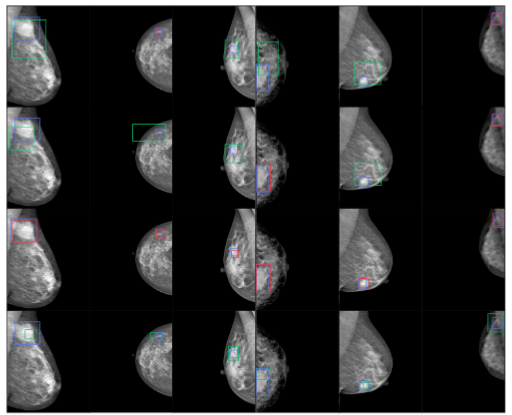
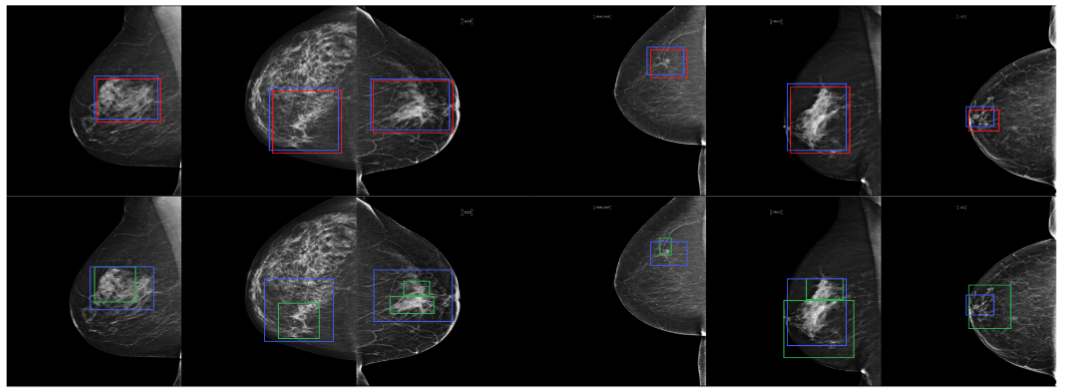
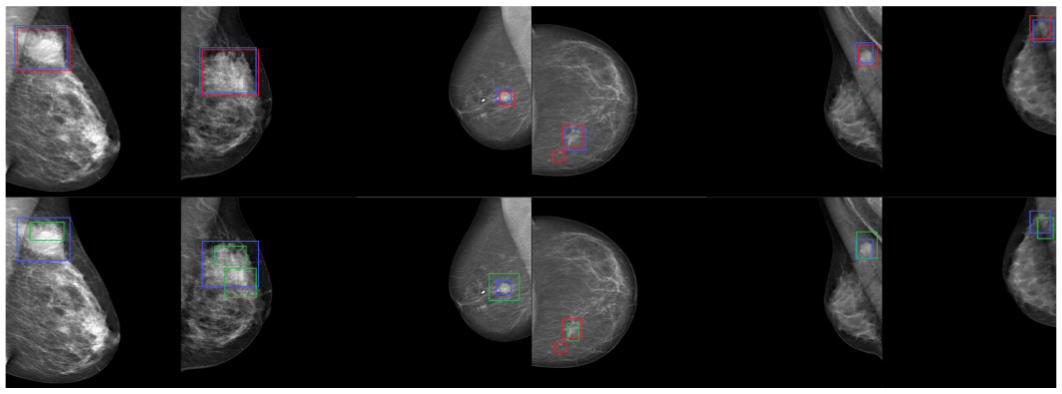
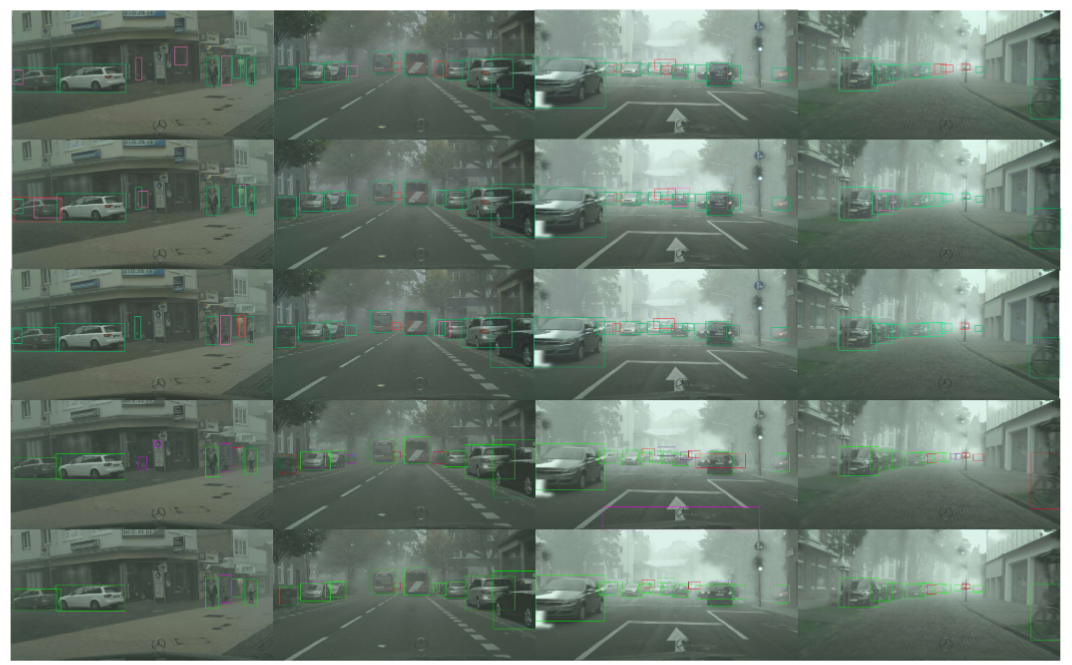
Visual comparisons of GT against prior SFOD methods across natural and medical domain transfers. Detection boxes are colour-coded:

  • Green — True Positive
  • Blue — Misclassified
  • Red — False Negative
  • Pink — False Positive

GT consistently recovers minority-class detections, trucks and buses in fog, and lesions in mammograms, that source-free baselines miss entirely.